
Hurst Boiler - Boiler Auxiliary Equipment
Feedmiser
Boiler Feedwater Systems
For More Information:

Sizes 30 to 1,000 gallons (Larger Sizes on Request) For all types of steam boilers with pressures to 300 psig.
The Hurst Feedmiser Automatic Return System provides storage for water make-up and return condensate from the system loop. The system consists of an elevated tank mounted boilers.
When equipped with optional trim, the Feedmiser provides a quality, heavy duty packaged unit fully assembled and ready to install. These units are factory assembled with pre-wired control panel, and fully piped pumps along with all the necessary fittings and valves. Consider the optional automatic steam preheater. When incorporated into the system, feedwater temperature can be maintained at 210°F. At this high temperature, oxygen and carbon dioxide are released, reducing corrosion problems in the boiler and piping system. Systems are available in single, dual, triple and quad pump configurations and custom orders are welcome.
Surface Blow-Off Heat Recovery Systems
The following trim shall be factory installed on each system:
- Automatic, internal float actuated fresh water make-up valve assembly.
- Water gauge glass set with bronze shut-off cocks and drain.
- Tank drain valve, brass gate.
- Bi-metallic water thermometer.
- Pump suction piping with shut-off valve and strainer.
Typical Optional Equipment:
- Control panel with motor starters & breakers.
- Pump function lights, selector switches.
- Diffuser tube for extra high temperature condensate return.
- High and low water level alarms.
- Pump alternator switches.
- Magnesium corrosion rod.
- Epoxy lining Manhole openings (200 gallon & larger).
- Electric solenoid valve make-up water assembly. Steam operated feedwater preheater.
- Discharge pressure gauges.
- Integrated Monitoring and Control Systems are available for all Deaerator and Feedwater options
Surface Blow-Off Heat Recovery Systems
Boiler Feedwater Systems
For More Information:
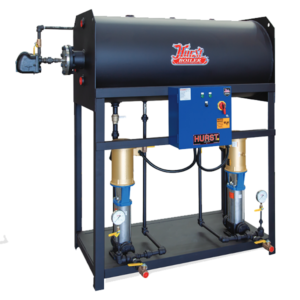
High temperature water purged from the boiler’s “surface” blow-off system carries valuable heat energy that is normally lost to the drain.
Although this seems wasteful, with the Hurst heat recovery system this discarded wasted energy can be reclaimed and transferred to the boiler make-up water with an increase of overall efficiency.
RECOVER 90%
or more of this continuous heat loss from this necessary and vital procedure. The continuous blowdown system controls boiler water quality and operating efficiency by removing suspended and dissolved solids from the surface water in the boiler vessel.
- Factory installed in the make-up water tank
- Includes steam trap trim piping
- Return on investment is possible in less than 12 months
- 316 stainless steel heat exchanger for long life and erosion resistant
- Reclaim up to 90% of the heat energy from surface water blow-off that would be lost
down the drain - Lower temperature of blowdown discharge to drain to meet local requirements
Oxymiser
Boiler Feedwater Systems
For More Information:
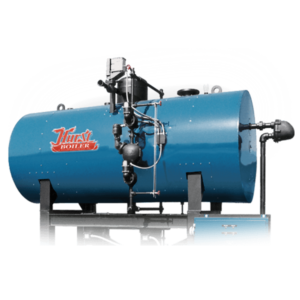
The Hurst “Oxymiser” deaerating boiler feedwater system eliminates the need of expensive oxygen scavenger chemicals and also offers the following advantages:
- Removes carbon dioxide as well as oxygen.
- Raises the boiler feedwater temperature, eliminating thermal shock in boilers.
- Improves overall boiler room efficiency.
- Feedwater pumps are sized for each individual application – assuring total compatibility and optimum operation.
- Vessels are ASME Code constructed for 50 psig.
- Compact design means smaller boiler room requirements
Why Deaerate?
The use of deaerators has long been used in power plants and water tube type boilers, primarily because they remove undissolved oxygen and raise the temperature of the feedwater. These advantages are important today for firetube boilers as well, due to higher capital investments. Operating costs can be reduced by recovering flash steam when returned by high temperature condensate. This feature also raises the feedwater temperature, thus requiring less boiler fuel to convert the feedwater to usable steam.
Boiler tubes, condensate lines, and process piping have a much longer useful life by eliminating the pitting action of untreated water. This advantage alone justifies the cost of an “OXYMISER” deaerator.
How Does It Work?
Fresh make-up water is fed into the deaerator through the inlet water connection. This water passes through the steam-filled heating and venting section. The water temperature is raised and many of the undissolved gases are released. As the water passes through the assembly, it flows to a scrubber section where final deaeration is accomplished by scrubbing the water with oxygen free steam. This steam is induced through a stainless steel spray valve assembly which causes the high velocity steam to break the water down to a fine mist through a violent scrubbing action. The deaerated water spills over to the tanks storage compartment for use by the boiler, and the gases are vented to the atmosphere.
Standard Equipment
- Welded steel tank, designed for 50 psig as per the requirements of ASME Code deaerating section with spray valve.
- Structural steel stand with square tubing and steel pump platform.
- Feedwater pump and motor sets, sized for each application.
- Water inlet valve assembly for condensate return and fresh water.
- Overflow trap, tank thermometer, pressure gauge.
- Steam pressure reducing valve assembly with temperature controller.
- Safety relief valve(s), vent valves, tank drain valve.
- Water gauge glass set with cocks, drain valve, and protection rods.
- Pump suction piping with strainer and shut-off valve.
- Integrated Control Panel
Dual Tank Deaerator
Boiler Feedwater Systems
For More Information:

The Hurst Dual-Tank Oxy-Miser “DOM” series boiler feed system is a spray-type Deaerator and condensate surge tank packaged together as a single unit sharing a common stand and pump header.
All Deaerators are ASME Section VIII unfired pressure vessels, which must be taken offline from time to time for inspection & maintenance as required by jurisdictional authorities and/or insurance providers. The Hurst DOM DA/ST combo tank is available with emergency cross-over piping which allows the surge tank to act as a temporary boiler feed system, keeping the boiler plant in operation while the DA is out of service.
Changing between the two tanks is a simple procedure. First, the DA is isolated from the boiler feed pump header by closing the butterfly valve located between the outlet flange of the DA and the boiler feed pump header. A second isolation valve in the pump header is then opened, allowing the boiler feed pumps to pull directly from the surge tank. Pump recirculation lines are re-routed to the surge tank with ball valves included with the factory piping. Once the Deaerator has been returned to service, the above steps are followed in reverse order, and the DOM tank is back in normal operating mode within a matter of seconds.
Why Deaerate?
The use of deaerators has long been used in power plants and water tube-type boilers, primarily because they remove undissolved oxygen and raise the temperature of the feedwater. These advantages are important today
for firetube boilers as well, due to higher capital investments. Operating costs can be reduced by recovering flash steam when returned by high-temperature condensate. This feature also raises the feedwater temperature, thus requiring less boiler fuel to convert the feedwater to usable steam.
Boiler tubes, condensate lines, and process piping have a much longer useful life by eliminating the pitting action of untreated water. This advantage alone justifies the cost of a DOM Series deaerator.
How Does it Work?
Fresh make-up water is fed into the deaerator through the inlet water connection. This water passes through the steam-filled heating and venting section. The water temperature is raised, and many of the undissolved gases are released. As the water passes through the assembly, it flows to a scrubber section where final deaeration is accomplished by scrubbing the water with oxygen-free steam. This steam is induced through a stainless steel spray valve assembly which causes the high-velocity steam to break the water down to a fine mist through a violent scrubbing action. The deaerated water spills over to the tank’s storage compartment for use by the boiler, and the gases are vented to the atmosphere.
The Hurst Dual-Tank Oxymiser deaerating boiler feedwater system eliminates the need of expensive oxygen scavenger chemicals and also offers the following advantages:
- Removes carbon dioxide as well as oxygen.
- Raises the boiler feedwater temperature, eliminating thermal shock in boilers.
- Improves overall boiler room efficiency.
- Feedwater pumps are sized for each individual application assuring total compatibility and optimum operation.
- Vessels are ASME Code constructed for 50 psig.
- Compact design means smaller boiler room requirements.
Standard Equipment
- Welded steel tank, designed for 50 psig as per the requirements of ASME Code deaerating section with spray valve.
- Structural steel stand with square tubing and steel pump platform.
- Feedwater pump and motor sets, sized for each application.
- Water inlet valve assembly for condensate return and fresh water.
- Overflow trap, tank thermometer, pressure gauge.
- Steam pressure reducing valve assembly with temperature controller.
- Safety relief valve(s), vent valves, tank drain valve.
- Water gauge glass set with cocks, drain valve, and protection rods.
- Pump suction piping with strainer and shut-off valve.
- Integrated Control Panel
Integrated Control Systems
Integrated Control System
For More Information:

The Hurst Boiler Firemaster Integrated Control System, an Industrial Internet-of-Things (IIoT) powered solution that delivers next-level boiler innovation and technology. Ideal for any industry, this advanced solution offers users the ability to remotely monitor boiler systems from anywhere, providing alerts and insights as well as actionable controls that help increase reliability, efficiency, safety and sustainability in the boiler room.
Integration of equipment and IT systems and has become essential for efficient operation of facilities of all sizes. Hurst developed and offers a full line of processor based smart controls fully compatible with all Hurst designs including alternative fuel models, including existing boiler upgrade and retrofit options for this new technology. Precise control of fuel and combustion air can result in very high efficiencies for boilers. Hurst intelligent control systems allow you to harness these savings while increasing overall boiler plant productivity.
Lower Fuel Costs
Optimizes the boiler lead/lag operation by continually monitoring the rate of change in steam pressure which allows multiple boilers to work together efficiently to achieve system set points. Reduces boiler on-off cycling due to system-load management.
Reduce Emissions
Reduces greenhouse gas emissions by maintaining proper air-to-fuel ratios.
BioMaster is a complete monitoring and automated control system providing intuitive control of the boiler, fuel-feed and peripheral equipment operation. With variables like fuel-moisture percentages and varying BTU values, achieving a constant and clean burn with solid fuels can be cumbersome. Through the HMI, the operator is given a dashboard view of all the motors, devices and processes relative to the operation of the boiler. From the main operator’s view, all points of the system are visible and can be easily accessed and controlled.
FireMaster is an on-board automated monitoring control system designed for the optimal control and operation of a single boiler/burner package.
BoilerMaster brings up to four of your boilers and equipment to a single collection control point. Now it is possible to monitor and manage your steam and hot water operations on-site from a user-friendly color touch screen, or remotely from off-site via secure internet by either computer or smartphone, or through a (SCADA) building automation system. Not able to be at the boiler room? Use the convenience of your office Ethernet network or the world wide web from anywhere, including from your smartphone, to access AND control the Firemaster system. Real-time data of efficiency and operating conditions are reported on a continual basis, and this information is archived daily into to the system’s history log and retrievable at any time. Utilizing the FireMaster’s array of options to suit your personalized boiler system enables the full power of the processor’s ability to manage and optimize over all efficiencies.
- FireMaster is fuel flexible- Burn gas and/or oil, with automated fuel changeover to maintain constant header pressure. Implemented Lead-Lag allows each boiler in the system to work simultaneously to maintain constant load pressure.
- Average target output range accommodates 300-2,500 HP. Surge tanks in this system support between 500-1,000 gallons. Guaranteed efficiency of 80%, FireMaster can reach 85%+ efficiency with optional Economizer. On-screen fuel management system includes steam flow totalization and real-time calculated efficiency.
- Huge user-friendly Siemens 19″ display- Simple to learn operator touchscreen interface, each interactive screen is designed for intuitive visual understanding with precise control.
- FireMaster uses LAN integrated Siemens S7-1200 series PLCs for process control.
- FireMaster uses Fireye servos for their finer degree of actuation, built in Modbus communication, and internal diagnostic reporting. Blowers are controlled by Siemens G120 VFDs for greater efficiency. FSG is Honeywell 7800 series (SCC LMV3 option available).
- FireMaster is designed to easily integrate with existing TCP communicating SCADA and data acquisition systems. Over 40 industrial protocols supported including BACnet, Modbus, EtherNet/IP, and more. Communication to Allen-Bradley/ Rockwell systems supported.
- FireMaster includes internet based remote tech support via a hardware VPN. Touch screen includes multi-language option.
- (Option) Draft sequence control.
- (Option) Cell modem for internet.
- (Option) Allen Bradley components available upon request.
- (Option) Native user defined data logging to LAN or internet accessible CSV files.
HVAC Software
HVAC Software
For More Information:
HVAC Solution Pro Software
What Does HVAC Solution Pro Software Do?
HVAC Solution Pro Software bridges the gap between HVAC Loads and Revit. Without HVAC Solution Pro Software an engineer is left to use rules of thumbs, perform hand calculations, use spread sheets and or standalone manufacturers individual equipment selection programs.
Engineers Workflow:
After loads have been completed and before equipment or systems are modeled in Revit or other modeling programs an engineer needs to do the following:
- Decide what the best types of systems are for the building.
- Sometimes this includes running an Energy Analysis to compare systems.
- Complete all the necessary system calculations.
- Static pressure of air systems, i.e. ductwork, terminal units, dampers, GRD’s all are needed to size RTU’s and fans properly.
- Head of hydronic systems, i.e. piping, boilers, RTU coils, tanks are all needed to size pumps properly.
- Ashrae 62 and 170 calculations as well as other Ashrae standards need to be looked at.
- Determine what the peak loads and capacities are so equipment can be selected.
- Select the equipment which meets the peak conditions.
- Create equipment schedules and many other coordination documents as well as obtain product documents of the designed equipment.
- Create Airflow, Hydronic Piping, Steam, Domestic, Refrigerant, VRF and Control System Schematics.
HVAC Solution Pro Software Workflow:
HVAC Solution Pro Software gives an engineer options on what type of system you want for your building. HVAC Solution Pro Software then completes all necessary calculations by integrating load data with system equipment. Piping and ductworks capacities are determined and automatically sized on the fly. Equipment is then automatically selected and scheduled. HVAC Solution Pro Software can complete all this work by answering questions in one of its many wizards, or a user can use the drag and drop feature.
Now that the HVAC system is completed, HVAC Solution Pro Software can create control diagrams, based on the most current system layout.
HVAC Solution Pro Software automatically complies and builds the following Schedules and coordination documents.
- Equipment Schedules – DXF, XLSX
- Materials List – DXF, XLSX
- Systems Schematics- DXF, JPG, PDF
- Controls Schedule – DXF, XLSX
- Electrical Schedule – DXF, XLSX
- Structural Schedule – DXF, XLSX
- Transfer Air Schedule – DXF, XLSX
- ASHRAE 62 Report – XLSX
- ASHRAE 170 Report – XLSX
- Detailed Report of Project –RTF
HVAC Solution Pro Software automatically retrieves the following manufactures product documents:
- Manuals, literature, specification.
- Cad, 2D, 3D, Revit, Submittals etc.
Summary:
An engineer then takes the HVAC equipment schedules and the DXF system schematics and places them in Revit. Then a two- or three-dimensional model is created in Revit to make sure equipment; ductwork and piping will fit in the given building. Approximately ½ of the mechanical costs of a project, i.e. all the equipment and controls can be designed around selected and schedule using HVAC Solution Pro Software.
What used to take days now takes hours!
What used to take hours now takes minutes with HVAC Solution Pro Software!
Blowdown Separators
Blowdown Separators
For More Information:

A boiler blowdown separator is designed to take water from the boiler during blowdown and reduce it to atmospheric pressure for disposal. The Hurst Boiler blowdown separator accomplishes this by separating the subsequent flashed steam from the hot water. As the blowdown enters the vessel, it is forced into a centrifugal pattern by means of a striking plate. The steam is vented to the atmosphere through a top connection. The Hurst boiler blowdown separator is built as per requirements Section VIII of the ASME Code and stamped by the National Board of Pressure Vessel Inspectors. The Hurst Boiler blowdown separator provides an economical means of safe boiler blowdown.
The separator includes a structural steel support stand for mounting to foundation. Options available are after cooler, manual cooling valve assembly, automatic cooling valve assembly, and exhaust heads.
Hurst Boiler Blowdown Separators are built to Section VIII, Division 1 of the ASME Code for 250 PSI design pressure. (200 PSI design pressure with 150# ANSI flanges) Blowdown separator design pressure should be a minimum of 25% of the boiler maximum allowable working pressure (MAWP) as recommended by the National Board.