
SVL Projects - Government & Public
Stanley Correctional Institution
This project demanded high-performance turndown and full compliance with a controls ecosystem the equipment wasn’t designed to support. Getting both at once was the real hill to climb.
Location
Stanley, WI
Consulting Engineer
INVI
Installing Contractor
JF Ahem & WHESCO Group
Project Details
Background
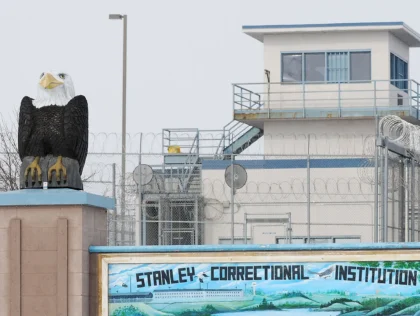
Stanley Correctional Institution needed a heating and domestic hot water system that could run efficiently and reliably year-round. But the original 1998 boilers weren’t built for today’s operating realities. With limited turndown capability, they cycled constantly—especially during low-demand periods—wasting energy, accelerating wear, and creating uneven performance.
Because the boilers also served domestic hot water year-round, that chronic short-cycling wasn’t just inefficient; it became a persistent operational headache.
Challenge
This wasn’t a straightforward boiler swap. The team had to identify a modern boiler/burner package that eliminated cycling while meeting Wisconsin’s strict control requirements. To truly solve the short-cycling issue, the facility needed a genuine 10:1 turndown, but achieving that level of performance within a mandated controls environment created a significant engineering challenge.
At the same time, DX split air handlers and condensing units were being designed during the industry transition from HFCs to A2L refrigerants, introducing additional code, design, and procurement hurdles.
SVL coordinated closely with code officials, engineers, contractors, and the owner to meet low-GWP requirements and future-proof the cooling systems—all without disrupting the critical heating and domestic hot water upgrade.
-
Oilon burners and Unilux boilers don’t typically interface with Rockwell Automation systems, which the State required.
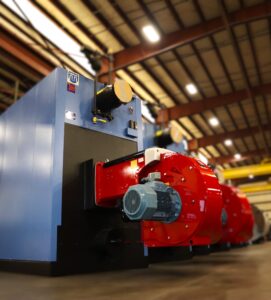
Shown above Oilon burner and Unilux boiler package. -
The State also mandated a specific controls contractor and required use of a MAXON SMARTLINK gas valve and Beck actuator—components not normally paired with this boiler/burner lineup.
-
That meant standard, off-the-shelf integration wasn’t possible.
-
The team needed a configuration that could accept external controls without compromising turndown performance or reliability.
-
Custom mechanical integration would be essential to make every piece operate as one coordinated system.
Solution
SVL, Oilon, Unilux, and WHESCO Group worked as a single team to engineer a customized system that cleared every obstacle.
Key moves that unlocked the solution:
-
Unilux boilers were delivered without factory controls, allowing full integration into the State’s Rockwell-based architecture.
-
Oilon burners were chosen specifically for reliable true 10:1 turndown, ensuring stable low-load operation through summer and shoulder seasons. While burner controls weren’t included, Oilon provided mounting provisions so Rockwell controls could be installed cleanly.
-
Custom Oilon-fabricated mounting brackets were created for the MAXON gas valve and Beck air damper actuator, ensuring precise alignment and consistent combustion performance.
-
WHESCO then engineered and installed the complete mandated controls package, including:
-
Rockwell Automation platform
-
MAXON SMARTLINK gas valve
-
Beck actuator for accurate air-damper modulation
-
This coordinated mechanical-and-controls integration delivered the required turndown and efficiency while staying fully compliant with State requirements.
End Result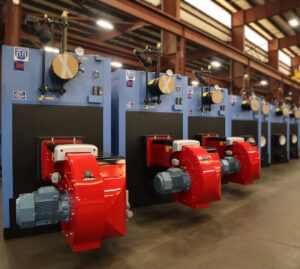
By overcoming the integration challenge, the new Oilon–Unilux system delivered the outcome the facility had been chasing for decades:
-
Smooth year-round operation with minimal cycling, cutting energy waste and extending equipment life.
-
True 10:1 turndown eliminates short-cycling even during low summer loads.
-
The institution is seeing meaningful energy cost reductions compared to the previous system.
-
State-mandated controls integration was achieved without sacrificing performance, improving system visibility and reliability.
-
Maintenance demands are down, performance is up, and the facility reports strong satisfaction.
-
The owner is extremely pleased with the system’s stability, efficiency, and long-term value.